Makeup
Blush for your face shape: where to apply it correctly
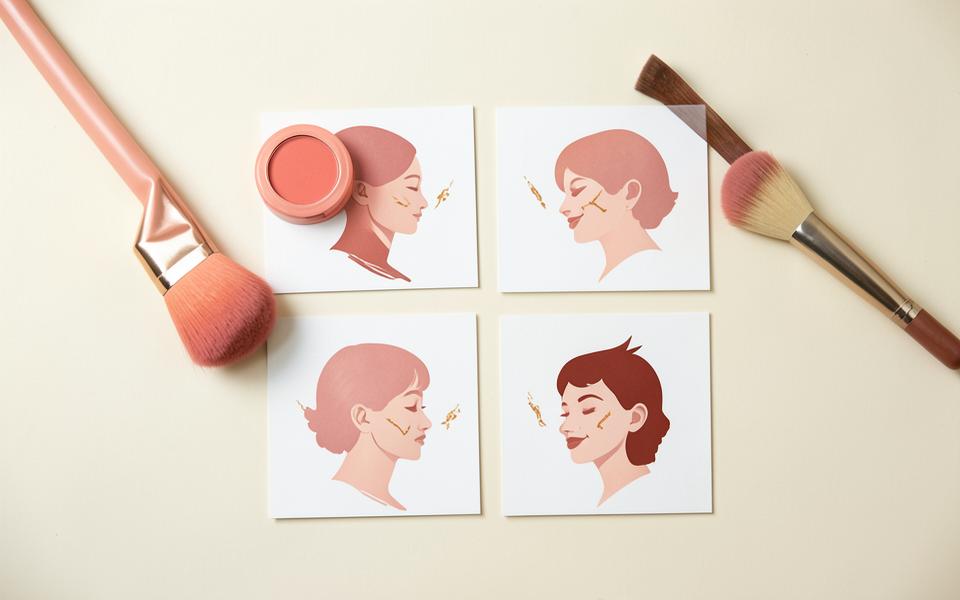
Most of us apply blush out of habit, to the same spot, our whole lives. Yet the same shade at two different heights gives two completely different faces: one lifted and narrower, the other lowered and wider.
The basic rule: direction of the stroke
Blush optically pulls the face in the direction you sweep it. A stroke upward and toward the temple elongates and lifts; a stroke horizontally across the cheekbone widens and rounds. That's why face shape decides the direction, not a trend from social media.
By face shape
Round face
Apply slightly higher than usual, on the highest point of the cheekbone, and sweep diagonally toward the temple. Avoid applying blush in a circle in the middle of the cheek — that rounds the face even further.
Elongated face
Work horizontally: apply blush across the cheekbone toward the nose and stop before the temple. This optically shortens the face and makes it look fuller.
Square face
A soft, slightly circular application in the middle of the cheekbone softens a strong jawline. The edges must be well blended — a sharp line emphasises the angles.
Heart-shaped face
The focus is lower, toward the middle of the cheek, to balance a wider forehead. Don't go high toward the temples.
Oval face
The classic placement — the highest point of the cheekbone with a light upward stroke. Everything works, so you can play with intensity.
Shade by undertone
- Warm undertone: peach, coral, warm terracotta, cinnamon.
- Cool undertone: cool pink, raspberry, plum, berry.
- Neutral undertone: soft pink-beige and "mauve" shades.
If you haven't determined your undertone yet, start with the piece on foundation for your skin undertone — the same undertone determines both blush and lipstick.
Formula and skin
Creamy blushes give an "inner glow" effect and suit dry skin better; powder formulas last longer on oily skin. On more mature skin, creamy blush looks younger because it doesn't emphasise texture.
The check test: step back two paces from the mirror. If you see the blush before you see the face — one more pass with a clean brush fixes the problem.
Frequently asked questions
How much blush is enough?
Less than you think for the first layer. Apply a thin layer, then build up — undoing too much pigment always means reapplying foundation.
Does blush go before or after contouring?
With powder formulas: contour, then blush. With creamy formulas: blush, then set with powder, then contour.
Can blush replace bronzer?
Partially, if it's a warm terracotta shade. For clear facial structure, combining the two works better — more in the piece on contouring for your face shape.
In closing
The shade of your blush depends on your undertone, and the placement on your face shape. Once you align those two decisions, blush stops being decoration and becomes the easiest correction in your makeup bag.
Related reading
How to contour your face by shape: a practical guide
Contouring isn't about drawing lines, it's about moving light. Once you know where your face needs shadow, two or three strokes are enough.
How to choose foundation according to your skin's undertone
The right foundation shade isn't a matter of luck. Once you know your undertone, the number of possible mistakes drops from dozens to two.
Which eyebrows suit me? Eyebrow shape for your face
Eyebrows are the frame of the face. Changing the arch height by two millimetres alters your expression more than a new makeup look.
Main guides